The Science of Discworld by Terry Pratchett Ian Stewart & Jack Cohen
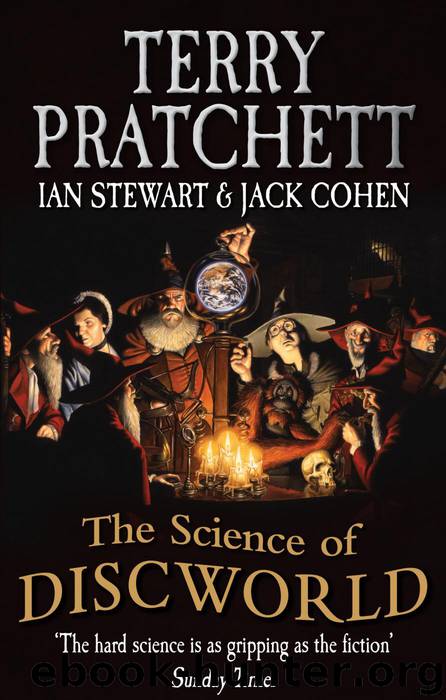
Author:Terry Pratchett, Ian Stewart & Jack Cohen
Language: eng
Format: epub
Publisher: Ebury Press
TWENTY-SIX
THE, DESCENT OF DARWIN
THE WIZARDS MET the God of Evolution in The Last Continent. He made things the way a god ought to:
“‘Amazin’ piece of work,” said Ridcully, emerging from the elephant. “Very good wheels. You paint these bits before assembly, do you?’”
The God of Evolution builds creatures piece by piece, like a butcher in reverse. He likes worms and snakes because they’re very easy – you can roll them out like a child with modelling clay. But once the God of Evolution has made a species, can it change? It does on Discworld, because the God runs around making hurried adjustments … but how does it work without such divine intervention?
All societies that have domestic animals, be they hunting dogs or edible pigs, know that living creatures can undergo gradual changes in form from one generation to the next. Human intervention, in the form of ‘unnatural selection’, can breed long thin dogs to go down holes and big fat pigs that provide more bacon per trotter.fn1 The wizards know this, and so did the Victorians. Until the nineteenth century, though, nobody seems to have realized that a very similar process might explain the remarkable diversity of life on Earth, from bacteria to bactrians, from oranges to orangutans.
They didn’t appreciate that possibility for two reasons. When you bred dogs, what you got was a different kind of dog – not a banana or a fish. And breeding animals was the purest kind of magic: if a human being wanted a long thin dog, and if they started from short fat ones, and if they knew how the trick worked (if, so to speak, they cast the right ‘spells’) then they would get a long thin dog. Bananas, long and thin though they might be, were not a good starting point. Organisms couldn’t change species, and they only changed form within their own species because people wanted them to.
Around 1850, two people independently began to wonder whether nature might play a similar game, but on a much longer timescale and in a much grander manner – and without any sense of purpose or goal (which had been the flaw in previous musings along similar lines). They considered a self-propelled magic: ‘natural’ selection as opposed to selection by people. One of them was Alfred Wallace; the other – far better known today – was Charles Darwin. Darwin spent years travelling the world. From 1831 to 1836 he was hired as ship’s naturalist aboard HMS Beagle, and his job was to observe plants and animals and note down what he saw. In a letter of 1877 he says that while on the Beagle he believed in ‘the permanence of species’, but on his return home in 1836 he began to think about the deeper meaning of what he had seen, and realized that ‘many facts indicated the common descent of species’. By this he meant that species that are different now probably came from ancestors that once belonged to the same species. Species must be able to change.
Download
This site does not store any files on its server. We only index and link to content provided by other sites. Please contact the content providers to delete copyright contents if any and email us, we'll remove relevant links or contents immediately.
| Fantasy | Gaming |
| Science Fiction | Writing |
We Ride Upon Sticks by Quan Barry(34498)
The Secret History by Donna Tartt(19007)
Norse Mythology by Gaiman Neil(13324)
Crooked Kingdom: Book 2 (Six of Crows) by Bardugo Leigh(12297)
The Betrayed by Igor Ljubuncic(11846)
The Betrayed by Matthew Dickerson(11617)
Caraval Series, Book 1 by Stephanie Garber(10240)
Year One by Nora Roberts(9767)
Twilight Siege: A Dark Fantasy Novel (The Fae Games Book 2) by Jill Ramsower(9603)
Oathbringer by Brandon Sanderson(9600)
The Priory of the Orange Tree by Samantha Shannon(9052)
The City of Brass by S. A. Chakraborty(8848)
Red Rising by Pierce Brown(8737)
Confessions of an Ugly Stepsister by Gregory Maguire(7864)
Little Fires Everywhere by Celeste Ng(7173)
This Is How You Lose Her by Junot Diaz(6862)
Shalador's Lady by Anne Bishop(6844)
Iron Flame by Rebecca Yarros(6838)
Storm and Silence by Robert Thier(6824)
